
Share this page


In late July, RDN's Senior Academic Advisor Emeritus Professor Roger Strasser AM and Senior Research Analyst Dr Brigitte Gerstl, represented the Australian Centre for Health Access (ACHA) and presented at the Australasian Association for Academic Primary Care’s (AAAPC) Annual Research Conference.
ACHA is a social enterprise of RDN - The Charity for Health Access which is dedicated to improving health access for under-resourced communities by turning research into real-world solutions. 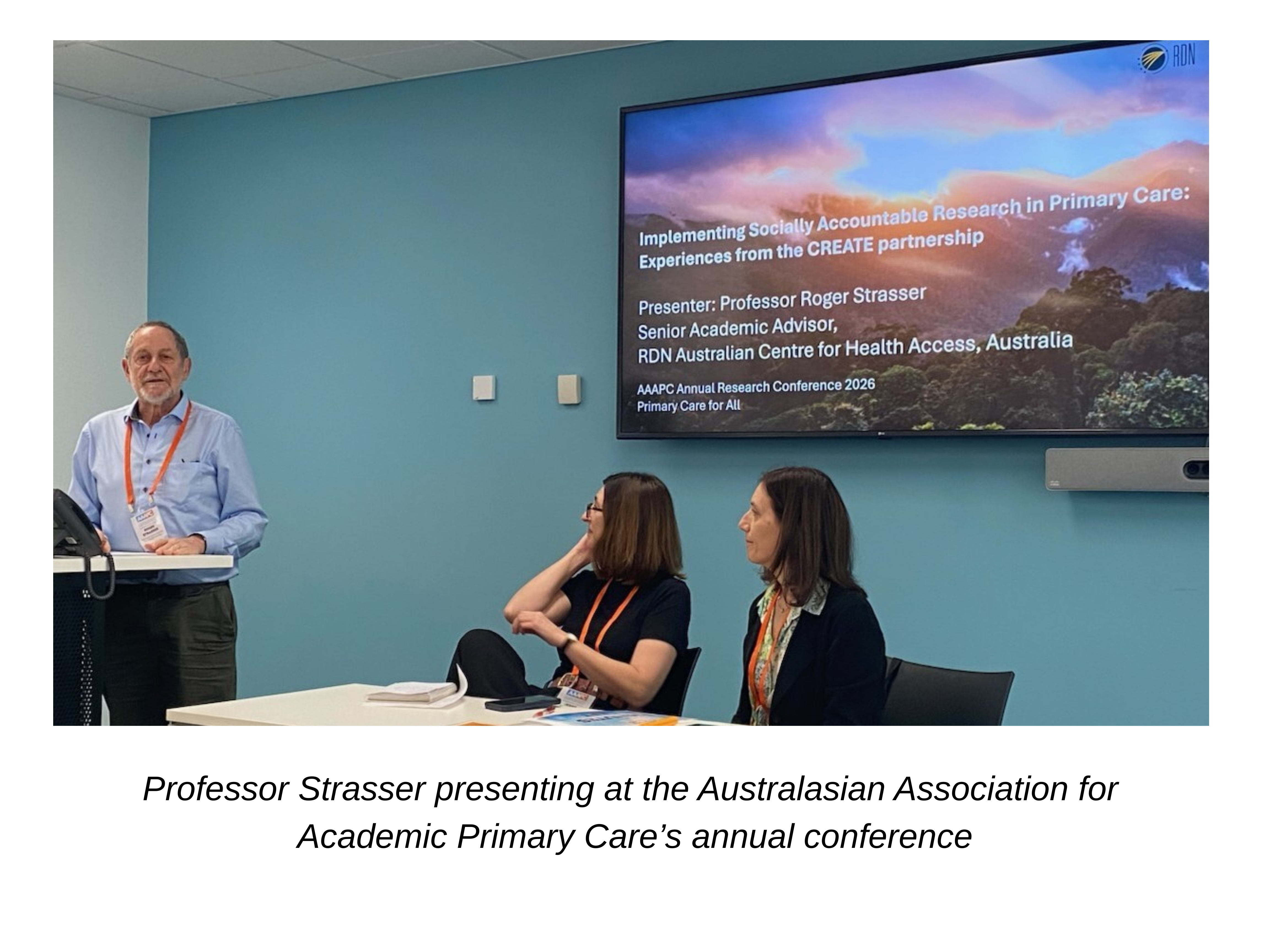
Held at the University of Wollongong Innovation Campus from 20-21 July, the AAAPC Annual Research Conference showcased Australasia's leading primary care research by nurturing research excellence, promoting multidisciplinary research networks and collaborations, supporting the translation of evidence into policy and practice, and strengthening the impact of primary care research.
Amongst a busy schedule of plenary presentations, oral presentations, poster walks and interactive workshops, all designed to inspire and educate, Professor Strasser presented his and Dr Gerstl's work – “Implementing Socially Accountable Research in Primary Care: Experiences from the CREATE Partnership”.
CREATE is a seven-year international collaboration involving six primary care sites. It examines how socially accountable research can be put into practice across different health service and research settings. Through ACHA, RDN hosts the CREATE Global Site and brings a rural health access focus to the collaboration.
Dr Gerstl said the conference provided an opportunity to share learning from CREATE and contribute to a wider discussion about how primary care research can be accountable to communities and health services.
“Research priorities, governance and measures of success must reflect community priorities as well as the practical conditions in which health services operate,” Brigitte said.
“Through ACHA, we brought a rural health access perspective to the discussion, including the workforce pressures, service constraints and local priorities that shape research in under-resourced primary care settings,” she said.
The presentation discussed early learning from CREATE, including:
the need for research priorities to be shaped by community-defined health concerns
shared decision making between communities, health services, policymakers and academic partners
the effect of workforce capacity, service pressures, funding requirements and institutional processes on research
the need to assess success through benefits to communities and services, rather than only through publications and grants
changes for the next phase of CREATE, include refining research questions, adjusting timelines and clarifying how success will be assessed.
The conference also included presentations on artificial intelligence and ethics in primary care, the gap between health system performance measures and patients’ lives, health service improvement, and equitable access to primary care.